

Photo by Steve_ a_ Johnson on Unsplash
For the past few years, I have been traveling frequently, sharing a deep love for travel with my father, who especially enjoys planning trips and navigating the visa process alongside me.
One day, I casually asked him, “Abu, what is your dream destination?”
Without hesitation, he replied, “London. I’ve always wanted to visit.”
In that moment, I saw a spark of excitement in his eyes. But as a Pakistani traveler, I also felt a familiar weight in my chest. I knew that for us, a dream isn’t just a flight ticket away, it is a long administrative battle.
So, we decided to plan our next New Year break in the UK.
I began researching the UK visa process and quickly learned that the most critical component was the bank statement. The requirement was clear: a “clean” financial record with transparent income and spending patterns. I spent nearly a year managing our accounts to meet this standard.
Once the financial documentation was finalized, I gathered the remaining materials, NOCs for my sister’s and my employment, university letters, and salary certificates.
Completing the applications took an entire day. I carefully listed every country we had visited, specifying months and years, ensuring that no detail was overlooked. After submitting the applications and paying the fees, we attended our biometric appointment and surrendered our passports. We were informed that a decision would arrive within three weeks.
Given our strong travel history and carefully prepared documentation, I felt confident and hopeful.
In the third week, the email arrived.
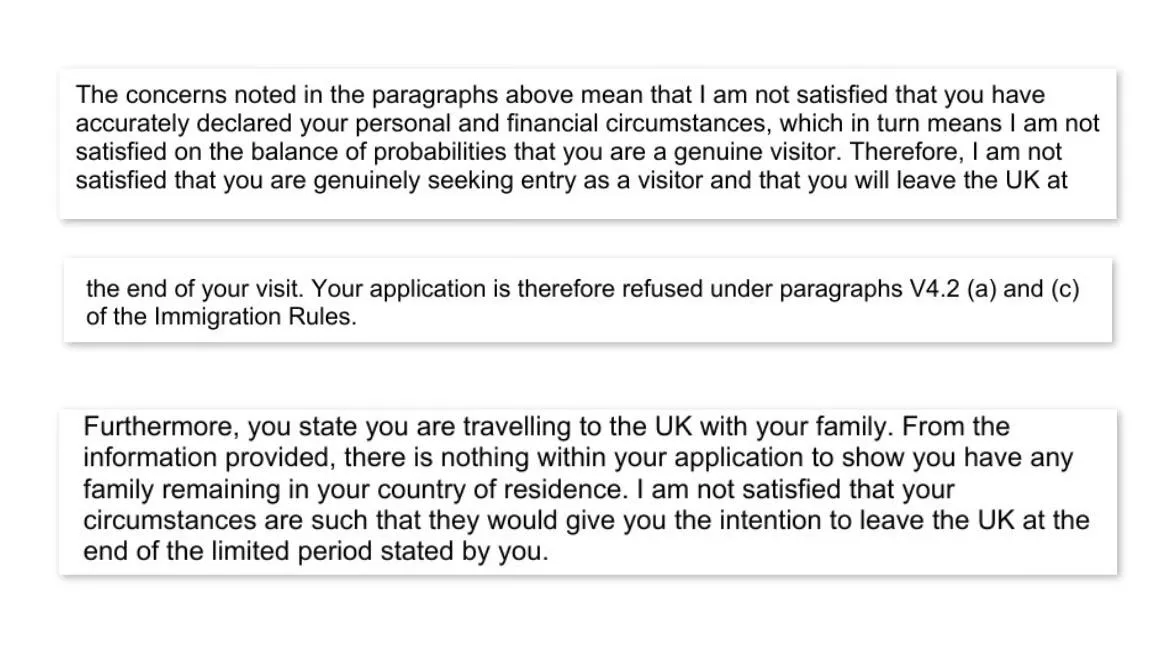
Our visas had been refused.
I froze. As I read the refusal letter, shock gave way to humiliation. The authorities questioned the authenticity of the funds I had spent a year organizing. They claimed our “ties to the country of residence” were unclear, despite the submitted evidence of employment, university enrollment, and business commitments in Dubai.
For my younger brother, a first-year university student, they demanded proof of his personal financial status, as if students are expected to independently fund international travel.
One particular justification was especially difficult to process: the claim that they were not convinced we would return to our country of residence after the trip.
While I am aware that Pakistani travelers are often viewed through a lens of suspicion due to past overstays by others, this reasoning exposed the collective punishment embedded within visa regimes. Individual credibility was irrelevant; nationality alone rendered us untrustworthy.
Genuine travelers were made to bear the consequences of actions they had never committed.
Each family member received a full-page refusal, dense with doubt and accusation, while the documentation we had carefully assembled was effectively ignored.
What followed intensified the sense of powerlessness. For more than fifteen days after the refusal, I received no communication regarding the return of our passports. During this period, I was unable to plan alternative travel or move forward.
Despite months of preparation, the trip collapsed entirely, not because of any procedural failure on our part, but because we existed outside the boundaries of birthright mobility privilege.
This rejection exposed how surveillance operates in visa systems. As Michel Foucault describes in his concept of the panopticon, embassies and visa officers function as contemporary panopticons. In this case, surveillance operates not through cameras but through constant examination. Bank statements, employment letters, and certificates become tools of control, and every line is analyzed for any kind of risk or deviance.
During this process, I was no longer a person with a stable job, a traveler with a clean record. I was reduced to a documentary file that had to appear both perfect and authentic, yet somehow still failed the test. We were frozen in place, rejected and silenced by a system that offered no explanation and no recourse. Rejection is not just an administrative process, it is an existential judgment that strips away legitimacy, trust, and the possibility of mobility.
Months of preparation. A year of financial planning. All reduced to a one-page refusal letter that questioned everything we were and assumed the worst of who we might become. The trip never happened. The passports eventually returned. The weight remained.